- Blair, Brexit, International Students and Small Boats — 25 Years of Widening “Doors”
- The Major Modern Shift Came After 1997
- In 2004, Britain Chose to Open Its Labour Market to Eastern Europe
- The Conservatives Promised to Cut Immigration
- After Brexit, Britain Opened Different Doors
- British Universities Became a Major Immigration Door
- Studying in Britain Became Closely Linked to Working in Britain
- It Was Not Only the Students
- The Same Pattern Appeared in Social Care
- Then Small Boats Were Added on Top
- Asylum Seekers Are Not the Same as Small-Boat Arrivals
- The Expansion of Legal Immigration Came First
- Population Can Rise Faster Than Housing, Schools and Hospitals
- Britain Is Now Tightening the Doors Again
- The “600,000 International Students” Target Has Disappeared
- The Britain Japan Imagined — and the Britain of Today
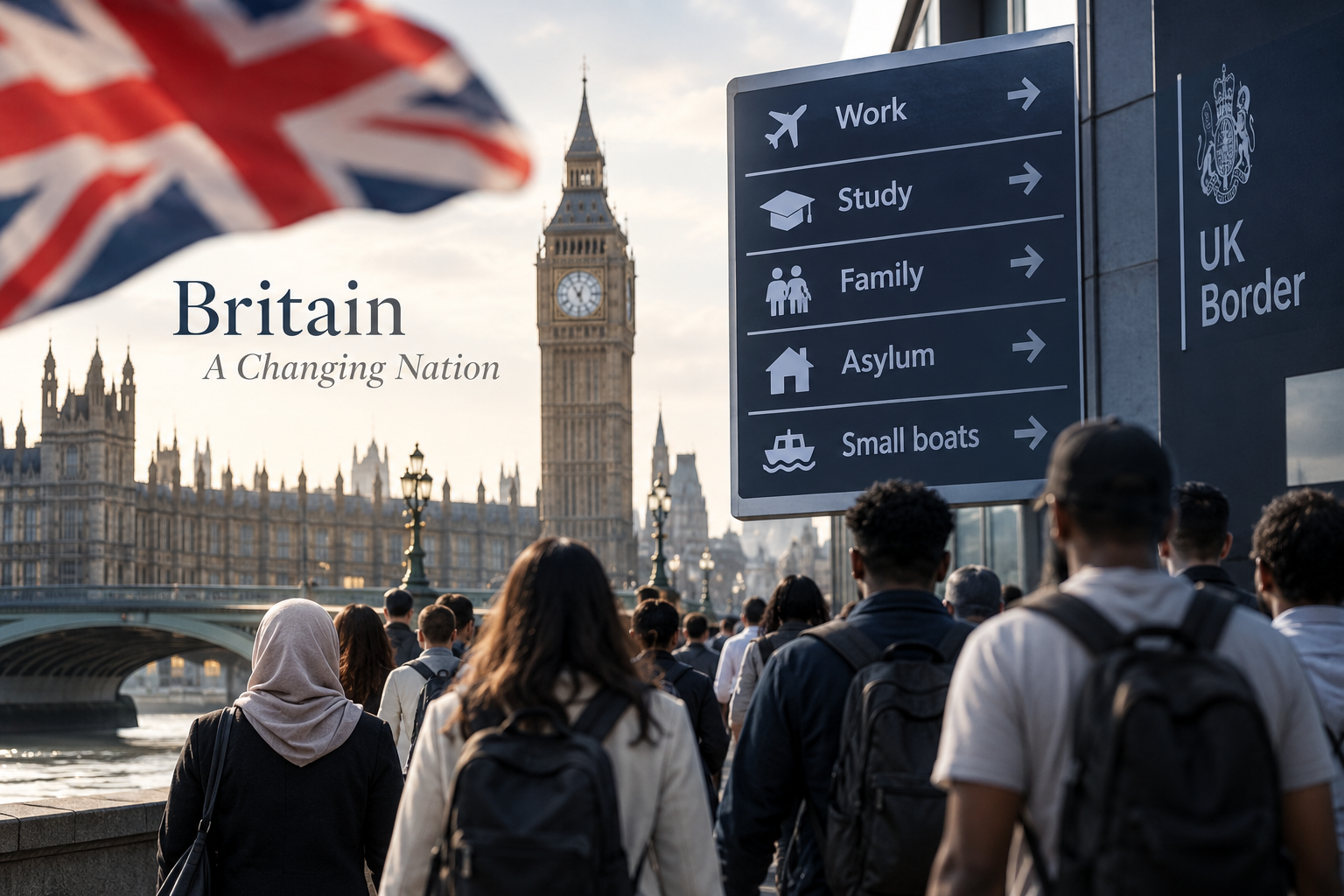
Blair, Brexit, International Students and Small Boats — 25 Years of Widening “Doors”
When Japanese people think of Britain, what comes to mind?
The Royal Family. Parliament. Historic streets. Pubs. Elite universities. The Premier League.
For better or worse, Britain has long been seen from Japan as a country deeply attached to its history and traditions.
Yet the news coming out of Britain today looks rather different.
Small boats crossing the English Channel. Confusion over asylum claims. Protests over immigration policy. Housing shortages and pressure on public services. And one word that refuses to leave the centre of British politics: immigration.
Why has a country so strongly associated with tradition become so deeply unsettled by immigration?
Looking into the numbers, the obvious explanation — that Britain reached this point because large numbers of illegal migrants suddenly arrived — does not tell the whole story.
Long before small boats became a dominant political issue, legal immigration had already expanded enormously.
And much of that expansion came through routes deliberately widened by British governments themselves.
The Major Modern Shift Came After 1997
Britain has a long history of immigration.
Its past as an empire and its ties to the Commonwealth mean that the story can easily be traced back to the post-war Windrush generation and the British Nationality Act of 1948.
But if we follow the numbers most directly connected with today’s immigration system, a much more recent break becomes visible.
Net migration to the UK was about 48,000 in 1997.
In 1998, it jumped to around 140,000, and thereafter remained above 100,000.
1997 was also the year Tony Blair’s Labour government came to power.
Of course, the rise in 1998 cannot simply be attributed to policies introduced by a government that had only just taken office.
But what followed was a genuine change in how the British government thought about immigration.
One of the clearest expressions of that shift came in the 2002 White Paper, Secure Borders, Safe Haven.
At its heart was the idea of “managed migration.”
Immigration was no longer treated simply as something to restrict. It could also be used to bring in workers and skills that the British economy needed.
Parliament later described this period as a major shift in direction, in which the economic value of migration was explicitly recognised.
Immigration policy and economic policy were becoming closely linked.
In 2004, Britain Chose to Open Its Labour Market to Eastern Europe
In May 2004, Poland and other Central and Eastern European countries joined the European Union.
Existing EU members were allowed to impose transitional restrictions of up to seven years on workers from the eight new Central and Eastern European member states, known as the A8.
Germany, France and many other countries chose to use those restrictions.
Britain did not.
Along with Ireland and Sweden, the UK opened its labour market to A8 workers immediately.
This was not something forced on Britain by the EU.
It was a choice made by the British government.
Migration from Eastern Europe then grew far beyond what had been expected.
Poland is the clearest example.
In England and Wales, the Poland-born population rose from around 58,000 in 2001 to roughly 579,000 in 2011.
That is almost a tenfold increase.
Over the same decade, the foreign-born population of England and Wales increased from 4.6 million, or 8.9% of the population, to 7.5 million, or 13.4%.
By 2021, it had reached around 10 million, or 16.8%.
Britain had, of course, been a country of immigration before Blair.
But if one is looking for a major modern turning point in the development of Britain as a high-immigration country, the period after 1997 — and particularly the decision of 2004 — is difficult to ignore.
The Conservatives Promised to Cut Immigration
In 2010, a Conservative-led government came to power.
David Cameron promised to reduce net migration from the “hundreds of thousands” to the “tens of thousands.”
The government did tighten student and family migration rules and closed a broad post-study work route.
But the target was never achieved.
Then, in 2016, Britain voted for Brexit.
One of the central slogans was “Take Back Control.”
Britain would control its own borders.
Immigration was one of the most important political issues surrounding the referendum.
At the end of 2020, free movement between the UK and the EU ended.
At first glance, one might expect immigration to have fallen sharply.
Instead, only a few years later, net migration reached its highest level on record.
After Brexit, Britain Opened Different Doors
A new points-based immigration system came into force in 2021.
EU and non-EU citizens were now, in principle, treated under the same framework.
At the same time, access for overseas workers was broadened.
The general salary threshold was lowered. The required skill level was reduced. Numerical caps were suspended, and the Resident Labour Market Test — which had required employers to show that they had first looked for workers in Britain — was abolished.
Britain closed the door of EU free movement while widening another door: legal labour migration from the rest of the world.
The result was a sharp fall in EU migration but a major increase in migration from outside the EU.
According to the latest estimates, UK net migration peaked at 944,000 in the year ending March 2023.
Britain had ended EU free movement, yet within only a few years it recorded the highest level of net migration in its history.
It is one of the great ironies of modern British immigration policy.
However, work and study were not the only reasons for the surge.
Humanitarian routes also temporarily added large numbers.
In 2022, long-term immigration through schemes for Ukrainians was estimated at around 114,000, while the Hong Kong British National (Overseas) route accounted for roughly 52,000.
Several different doors widened at the same time.
British Universities Became a Major Immigration Door
One of those doors was education.
In 2019, the Conservative government published its International Education Strategy.
The targets were explicit.
Britain wanted to attract 600,000 international students a year by 2030 and increase education exports to £35 billion annually.
Growing the number of international students was therefore not an accidental side effect.
It was government economic policy.
The 600,000 target was reached well before 2030.
Why did Britain want so many international students?
University finances provide part of the answer.
In the 2024/25 academic year, UK higher education institutions had 685,565 international students, representing 24% of all students.
Tuition-fee income from international students reached £12.4 billion.
That was 23% of total university income.
In the mid-1990s, the figure had been around 5%.
Tuition fees for domestic students are capped.
International fees are not capped in the same way.
As the real value of domestic tuition income declined and university finances came under pressure, international students paying much higher fees became increasingly important.
Parliament has also noted that this income effectively helps subsidise teaching and research for domestic students.
The government wanted education exports.
Universities wanted fee income.
Then another factor was added.
Studying in Britain Became Closely Linked to Working in Britain
In 2021, Britain introduced the Graduate route.
More precisely, it restored a broad post-study work route after a previous version had been closed in 2012.
International graduates of UK universities could remain in Britain for a period after graduation and work without first securing sponsorship from an employer.
That changed the meaning of studying in Britain.
The pathway became:
Study in Britain → stay after graduation → work in Britain → switch into a longer-term work visa
A Home Office survey cited by the Migration Advisory Committee found that among users who were aware of the Graduate route, 73% said it had influenced their decision to study in the UK.
Among those respondents, 34% said they would not have come to Britain to study without the route.
That matters.
International students were no longer only customers of Britain’s education industry.
For some, studying became the first stage of a longer path into the British labour market.
Education policy and immigration policy had become connected.
It Was Not Only the Students
The number of dependants accompanying students also rose dramatically.
In the year ending March 2023, 149,400 student dependant visas were issued.
Dependants represented 24% of all student-related visas.
In 2019, the corresponding figure had been just 13,518, or 6%.
India and Nigeria accounted for much of the increase.
Together they made up around 73% of student dependant visas during the period.
For Nigerian nationals, the numbers were striking:
57,636 student visas
66,796 dependant visas
There were more dependants than principal student applicants.
The simple image of “one international student arriving to study” no longer captured the full scale of the population movement.
In 2024, the government restricted the right of most postgraduate students to bring dependants.
Once again, the pattern was familiar:
The door widened. Numbers surged. The government tightened it afterwards.
The Same Pattern Appeared in Social Care
After Brexit, Britain also became increasingly dependent on overseas workers in health and social care.
The number of main applicants on the Health and Care Worker visa rose from around 31,800 at the end of 2021 to 145,823 by the end of 2023.
Much of the increase came from South Asia — including India, Pakistan and Bangladesh — and sub-Saharan Africa, including Zimbabwe, Ghana and Nigeria.
The logic was understandable.
Britain had severe labour shortages in care.
Overseas workers could fill them.
But the movement did not stop with the worker.
In 2023, there were 145,823 main Health and Care Worker applicants, but 202,334 dependants.
Dependants outnumbered the principal applicants.
Concerns also grew over abuse of the system, rogue sponsors and exploitation of foreign workers.
The government later restricted dependants for care workers and, in 2025, closed the route to new overseas recruitment into social care.
Again, a door had been opened widely and later narrowed.
Then Small Boats Were Added on Top
Most of the immigration described so far was legal immigration authorised by the British government.
But another problem emerged on top of that already enlarged base.
Small boats crossing the English Channel.
In the year ending June 2026, 38,086 detected irregular arrivals were recorded.
Of these, 33,374 — 88% — arrived by small boat.
Compared with a net-migration peak of more than 900,000, small boats were not the main numerical driver of immigration.
Politically, however, their impact was far greater than the raw numbers suggest.
The government was already admitting large numbers of legal migrants.
At the same time, tens of thousands of people were arriving every year across the Channel outside the normal immigration-control system.
Britain had voted for Brexit partly on the promise of regaining control of its borders.
Yet small-boat crossings continued.
For many voters, the obvious question became:
“Is the government actually in control of the border?”
That gap between the political promise and what people could see happening became one reason small boats took on such symbolic importance.
Asylum Seekers Are Not the Same as Small-Boat Arrivals
Asylum makes the picture even more complicated.
In the year ending June 2026, around 86,000 people claimed asylum in the UK.
Their routes into Britain were very different.
Around 40% arrived by small boat.
Another 12% came through other irregular routes.
But 41% had entered Britain with some form of regular status, such as a visa, before later claiming asylum.
So:
small-boat arrivals are not the same thing as asylum seekers.
And:
asylum seekers are not the same thing as illegal entrants.
Some people enter legally as students, workers or visitors and later make an asylum claim.
Britain’s immigration system has become too complex to explain through any single route.
The Expansion of Legal Immigration Came First
Put all of this together and the reason Britain now appears so unsettled becomes easier to see.
The story did not begin with small boats.
Before that, a series of legal migration routes had already expanded:
EU workers.
Non-EU workers.
International students.
Post-study workers.
Health and care workers.
And the dependants attached to several of those routes.
As a result, the foreign-born share of the population in England and Wales rose from:
8.9% in 2001 13.4% in 2011 16.8% in 2021
On top of that enlarged base came small boats, irregular entry and rising asylum claims.
The expansion of legal immigration came first. On top of it came forms of migration that were much harder for the government to control.
That order matters when trying to understand modern Britain.
Population Can Rise Faster Than Housing, Schools and Hospitals
There is another important part of the story.
A population can increase quickly.
Housing, schools, hospitals, transport and local government services cannot necessarily expand at the same speed.
And migrants do not settle evenly across the country.
Analysis of the rise in the foreign-born population between 2001 and 2011 found that around three quarters of the increase was concentrated in only a quarter of local authorities.
An increase that may look manageable in national statistics can therefore feel much larger in particular towns and cities.
The pressure can show up in housing markets, schools, health services, transport and local administration.
Britain’s own government has increasingly focused on the scale, pace and composition of migration, acknowledging that poorly managed migration can place pressure on housing, public services and community relations.
The key question is not only how many people enter the country.
It is also:
Where do they settle, and how quickly does the local population change?
The experience of demographic change at neighbourhood level can be far more dramatic than the national average suggests.
That is part of the reason immigration has generated such strong political discontent.
Britain Is Now Tightening the Doors Again
Britain has clearly begun to change direction.
Dependants have been restricted for many international students.
New overseas recruitment into social care has been closed.
Requirements under the Skilled Worker system have been tightened.
After these changes, work- and study-related immigration fell sharply.
According to the latest ONS estimate, net migration declined from:
944,000 in the year ending March 2023 to a provisional 171,000 in the year ending December 2025.
But net migration is the difference between arrivals and departures.
The fall is not explained only by tighter entry rules.
It also reflects higher emigration by people who arrived in earlier years, including former students and workers.
And the latest figure remains provisional and could be revised.
Even so, the change in the composition of migration following policy changes is striking.
Government policy can widen immigration routes.
Government policy can narrow them again.
The “600,000 International Students” Target Has Disappeared
One particularly symbolic change can be seen in the UK’s 2026 International Education Strategy.
In 2019, the government had openly set a target of attracting 600,000 international students a year.
In the 2026 strategy, that headline numerical target is no longer at the centre of policy.
Instead, the language now emphasises ideas such as:
“sustainable recruitment” “high-quality international students” “responsible recruitment”
Britain still wants to expand education exports, now targeting £40 billion by 2030.
But the emphasis has changed.
The question is no longer simply how many students can be brought into Britain.
The focus has shifted toward how international education can be expanded in a more sustainable way, including through British education delivered overseas.
The language itself has changed.
From “bring more” to “how should they be brought in?”
Britain has begun correcting the policies of the previous era.
The Britain Japan Imagined — and the Britain of Today
The reason I began looking into Britain’s immigration problem was simple.
Britain has a long history, a monarchy and a strong reputation for tradition.
So why has immigration become such a destabilising political issue?
And is today’s Britain already very different from the Britain people in Japan have long imagined?
What becomes clear is that Britain did not change overnight.
The Blair government moved immigration policy toward the active use of migration as an economic tool.
In 2004, Britain opened its labour market immediately to workers from Eastern Europe.
The Conservatives later promised to reduce immigration and delivered Brexit, but after Brexit they widened new routes for non-EU workers.
The government encouraged international students as an export industry, while universities became increasingly dependent on the higher fees they paid.
The Graduate route linked studying in Britain to working in Britain.
Health and social care shortages led to a sharp rise in overseas recruitment, in some years accompanied by even larger numbers of dependants.
Then, on top of that already enlarged base of legal migration, came the political crises surrounding small boats and asylum.
What happened in Britain is not a simple story of “the border suddenly breaking.”
Economic growth.
University finances.
Labour shortages.
International competition.
Humanitarian obligations.
Taken separately, each policy had its own logic.
But when all of the different doors opened for different reasons are added together, the result was an enormous movement of people into British society.
Britain is now beginning to close some of those doors again.
The “traditional Britain” long visible from Japan is still there.
The Royal Family remains. Parliament remains. Historic streets and pubs remain.
But inside that tradition, the people who live there — and the shape of British society itself — have changed over the past 25 years far faster than many people in Japan may have imagined.