When people think of SpaceX, they usually think of rockets.
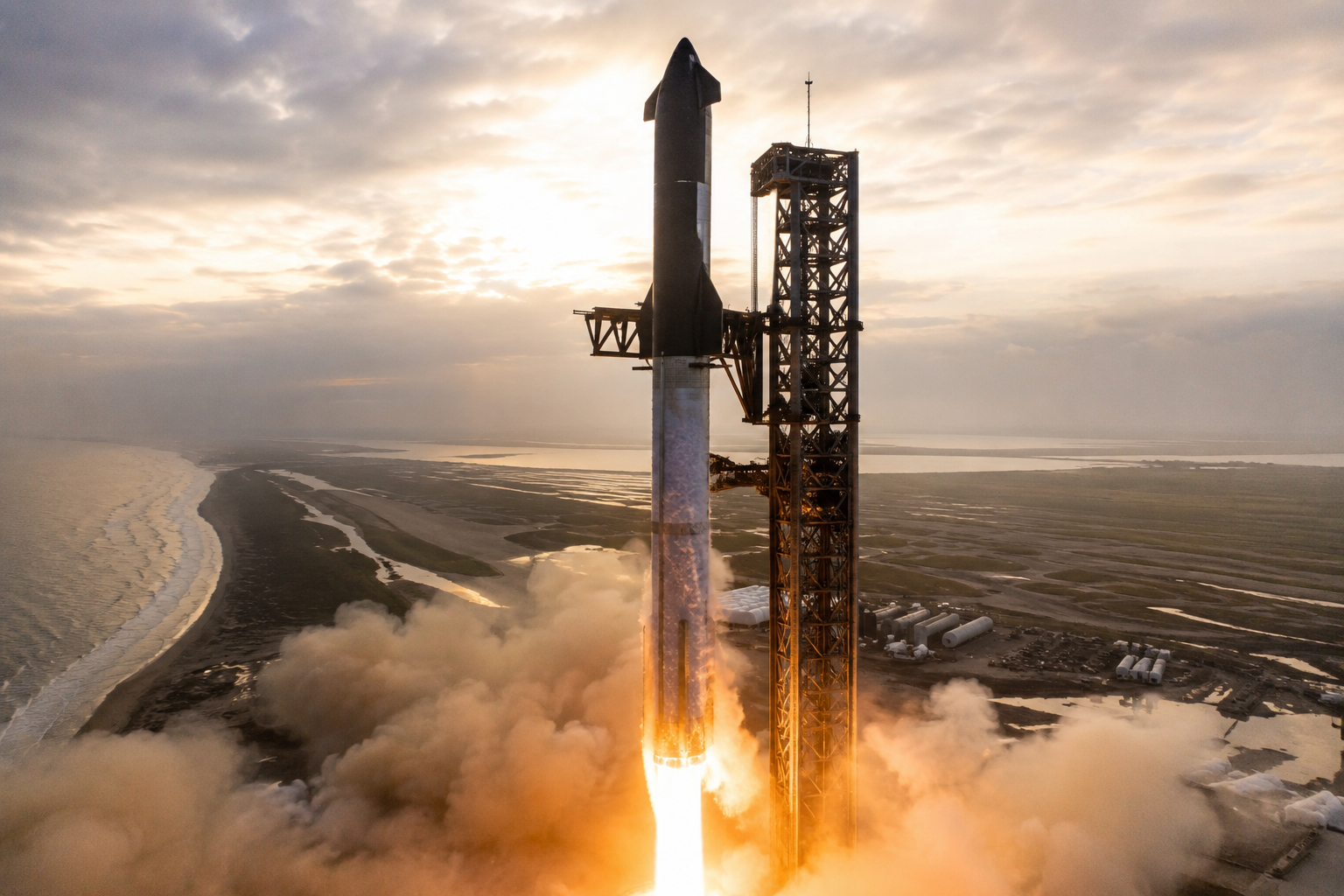
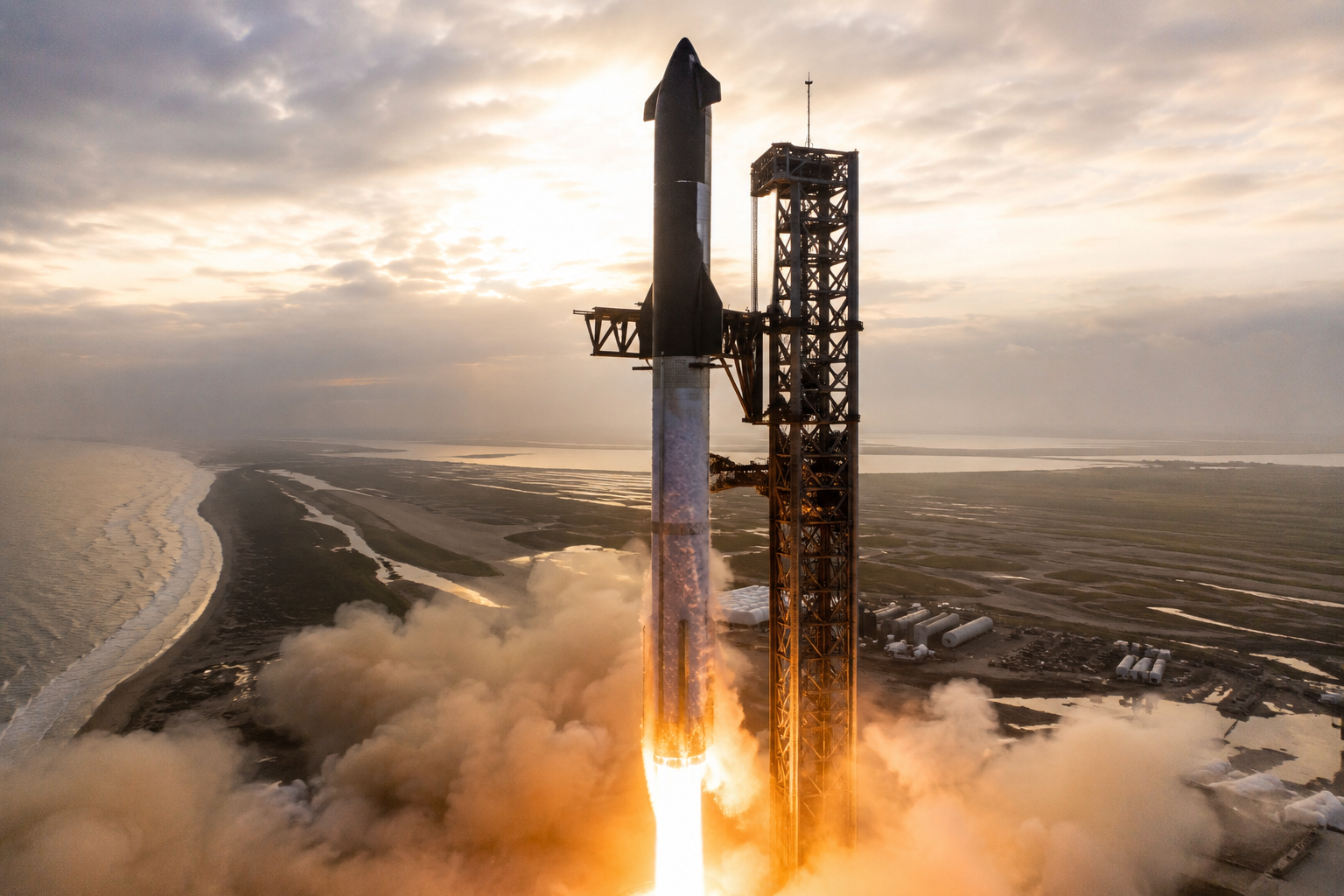
Starship.
Starlink.
Mars.
But by 2026, describing SpaceX simply as a space company no longer seems sufficient.
AI is moving toward the center of the company’s strategy.
Grok.
Massive AI data centers.
Terafab.
Tesla Megapacks.
Optimus.
Autonomous vehicles.
Starlink.
Starship.
And eventually, AI computing infrastructure in orbit.
At first glance, these may look like separate businesses spread across several Elon Musk companies.
But when SpaceX’s SEC filings are read alongside Tesla’s financial disclosures, Tesla’s Master Plan Part IV, and Musk’s own recent statements, a different picture begins to emerge.
What if these businesses are not separate at all?
What if Musk is attempting to build the entire physical infrastructure required to operate AI at civilization scale?
■ The most important phrase in SpaceX’s filings: “physical stack”
Much of today’s AI competition focuses on intelligence.
Which model is smartest?
Which model performs best on benchmarks?
Which system can reason, code or understand the world most effectively?
But SpaceX frames the problem differently.
In SEC filings, SpaceX identifies some of the major constraints on continued AI growth as physical:
semiconductor manufacturing,
data-center infrastructure,
and power generation.
SpaceX goes even further.
It argues that the future of AI will increasingly be determined by control of the “physical stack.”
That phrase may be the key to understanding what Musk is building.
AI may appear to be software.
But intelligence at enormous scale requires an enormous physical machine underneath it.
Chips.
Factories.
Data centers.
Electricity.
Energy storage.
Networks.
Cooling.
Transportation.
And eventually robots capable of acting in the physical world.
As AI systems grow, the bottleneck may increasingly shift from intelligence itself to the infrastructure required to run it.
SpaceX appears to be positioning itself directly around that bottleneck.
Source:
SpaceX SEC filings
https://www.sec.gov/Archives/edgar/data/1181412/000162828026041013/japanfwp_06042026.htm
■ SpaceX is becoming an AI company
In an all-hands meeting made public in August 2026, Musk made an extraordinary series of predictions about SpaceX’s AI business.
He said AI revenue could surpass revenue from SpaceX’s other businesses as early as September 2026 and greatly exceed those segments in the fourth quarter.
Musk also suggested that if SpaceX could bring 10 gigawatts of AI compute online by the end of 2027, it could potentially generate between $300 billion and $500 billion in annual revenue.
And looking further ahead, Musk predicted that AI could represent 99% of SpaceX’s value within roughly five years.
These numbers are enormous.
They must also be treated carefully.
They are Musk’s projections — not formal SpaceX financial guidance, and not guaranteed outcomes disclosed in an SEC filing.
But they reveal something important about how Musk himself now sees SpaceX.
AI is not being treated as a side project.
It is increasingly being presented as central to the company’s future.
■ Cursor joins SpaceX
That shift became even more visible in August 2026.
Cursor announced that it had become part of SpaceX.
The move followed earlier collaboration with SpaceXAI around model training and development.
This matters because software development itself is one of the most important interfaces between humans and increasingly capable AI systems.
SpaceX is therefore not only building infrastructure underneath AI.
It is also expanding its presence in the tools used to create software with AI.
Source:
Cursor — Joining SpaceX
https://cursor.com/blog/joining-spacex
■ Then comes Terafab
If AI is constrained by chips, one obvious solution is to gain greater control over chip production.
That is where Terafab enters the picture.
SpaceX has described plans to deepen strategic collaboration with Tesla and Intel around a massive semiconductor manufacturing initiative.
The long-term ambition is extraordinary:
one terawatt of compute hardware production capacity per year.
The concept goes beyond a conventional semiconductor fab.
SpaceX has described an integrated manufacturing system potentially spanning mask production, logic and memory fabrication, and advanced packaging.
And the chips would not serve only one purpose.
Some would support AI operating on Earth — including Tesla vehicles and Optimus.
Others would be optimized for AI computing systems operating in space.
Intel joined the Terafab initiative in April 2026 and is expected to contribute expertise in high-performance chip design, manufacturing and packaging.
But there is an important qualification.
SpaceX has also told the SEC that participation in specific Terafab projects remains subject to further negotiations, agreements and approvals.
Tesla and Intel are not simply obligated to participate in every future project.
Terafab should therefore be understood as an enormous strategic direction — not as a fully completed industrial system.
Source:
SpaceX SEC filings
https://www.sec.gov/Archives/edgar/data/1181412/000162828026041013/japanfwp_06042026.htm
■ Tesla is no longer simply a car company either
The same transformation can be seen at Tesla.
Tesla’s Master Plan Part IV brings together solar generation, large-scale battery storage, autonomous transportation and humanoid robotics.
Tesla describes an ecosystem spanning transportation, energy generation, battery storage and robotics.
This is important because Tesla increasingly provides something AI companies desperately need:
a bridge between intelligence and the physical world.
AI can make decisions.
Tesla’s machines can act on them.
Cars can move.
Robotaxis can transport people.
Optimus can perform physical work.
Energy systems can store and distribute electricity.
Tesla’s role begins to look less like “an electric-car company” and more like a physical execution layer for AI.
Source:
Tesla — Master Plan Part IV
https://www.tesla.com/master-plan-part-4
■ The financial connections are already real
The relationship between Musk’s companies is not merely philosophical.
Money is already moving between them.
According to Tesla’s 2025 Form 10-K, sales of Megapacks to xAI generated approximately $430 million in revenue for Tesla during 2025.
Source:
Tesla — 2025 Form 10-K
https://www.sec.gov/Archives/edgar/data/1318605/000162828026003952/tsla-20251231.htm
Tesla’s 2026 first-quarter filing also disclosed Megapack sales to SpaceX generating approximately $87 million in revenue.
These transactions reveal a very simple relationship:
AI
↓
massive electricity demand
↓
energy storage
↓
Tesla Megapack
The connection between AI and energy is no longer theoretical.
It is already commercial.
■ AI is becoming an energy problem
This may become one of the defining issues of the AI era.
The larger AI systems become, the more electricity they require.
Building more compute therefore means building more power infrastructure.
And that creates another bottleneck.
Power plants.
Transmission lines.
Grid connections.
Permitting.
Land.
Cooling.
Water.
Musk has long argued that humanity already has access to an enormous fusion reactor:
the Sun.
When asked about fusion in 2021, he pointed to the Sun as the giant fusion reactor already available to us and advocated solar power combined with batteries.
His approach is revealing.
Instead of waiting for a technological miracle, deploy technologies that already work — then manufacture them at enormous scale.
Solar panels.
Batteries.
Storage.
Factories.
This same philosophy appears repeatedly across Musk’s companies.
■ Musk’s real obsession may be scale
Tesla did not invent the electric car.
It did not invent the solar panel.
SpaceX did not invent the rocket.
Musk did not invent artificial intelligence.
Nor did his companies invent batteries, robotics or satellites.
What his companies repeatedly attempt to do is something different:
take existing technologies,
manufacture them at enormous scale,
drive costs downward,
integrate them,
and deploy them faster than previously seemed practical.
SpaceX made rockets reusable.
Starlink turned satellites into a mass-manufactured network.
Tesla industrialized electric vehicles at global scale.
Megapack industrialized grid-scale battery storage.
Optimus attempts to apply manufacturing scale to humanoid robotics.
Terafab would attempt something similar with AI compute hardware.
This may be the common philosophy connecting the entire system.
■ But Earth creates limits
There is a problem.
If AI compute continues expanding exponentially, terrestrial infrastructure may eventually become the constraint.
Electric grids cannot expand infinitely quickly.
New power plants require land and permits.
Data centers require cooling and water.
Transmission infrastructure takes years to build.
At some point, scaling AI on Earth may become increasingly difficult.
SpaceX’s answer is radical:
move part of the computing infrastructure off Earth.
■ Orbital AI computing
SpaceX’s SEC filings describe plans to extend AI computing infrastructure into orbit.
The company has discussed deploying AI compute satellites potentially beginning as early as 2028.
These satellites could use large solar arrays for energy and AI accelerators optimized for operation in space.
Starlink’s experience with satellite manufacturing and inter-satellite laser communications could provide the networking layer.
Starship could provide the transportation system required to deploy the hardware at unprecedented scale.
SpaceX has even discussed a long-term ambition of deploying approximately 100 gigawatts of compute capacity into orbit per year.
That would require an extraordinary launch system.
SpaceX itself estimates that achieving such scale could require roughly one million metric tons of payload delivered to orbit annually and thousands of Starship launches.
This is not a near-term certainty.
SpaceX itself acknowledges substantial technological, operational and execution risks.
Orbital AI computing at this scale has never been demonstrated.
But the architecture is now visible.
Source:
SpaceX SEC filings
https://www.sec.gov/Archives/edgar/data/1181412/000162828026041013/japanfwp_06042026.htm
■ Why SpaceX already owns many of the pieces
Imagine trying to build orbital AI infrastructure from scratch.
You would need a reusable heavy-lift rocket.
SpaceX has Starship.
You would need mass-produced satellites.
SpaceX already manufactures satellites at industrial scale.
You would need a global communications network.
SpaceX has Starlink.
You would need inter-satellite communication.
Starlink already uses laser links between satellites.
You would need enormous amounts of AI hardware.
Terafab is intended to address that.
You would need AI itself.
SpaceX has increasingly integrated AI operations and Grok.
You would need software-development infrastructure.
Cursor is now part of SpaceX.
You would need energy.
Solar power is abundant in space.
And on Earth, Tesla provides large-scale battery storage through Megapack.
Finally, you would need AI to act in the physical world.
Tesla has autonomous vehicles and Optimus.
Seen separately, these are different businesses.
Seen together, they begin to resemble layers of the same machine.
■ The AI business is already becoming commercial infrastructure
There is another important piece of evidence.
In June 2026, SpaceX entered into a Cloud Service Agreement with Google covering access to large-scale compute capacity.
The infrastructure includes approximately 110,000 NVIDIA GPUs, along with CPUs, memory and other related components.
Under the agreement, Google is scheduled to pay approximately $920 million per month from October 2026 through June 2029, with the amount depending on the agreed compute capacity and subject to termination and adjustment provisions.
This matters because it shows that SpaceX’s AI infrastructure business is not purely a distant orbital vision.
Large-scale commercial AI infrastructure already exists on the ground.
And that creates an important bridge between the two sides of SpaceX’s strategy:
terrestrial AI infrastructure today,
and potentially orbital AI infrastructure tomorrow.
Source:
U.S. Securities and Exchange Commission — SpaceX Free Writing Prospectus, June 2026
https://www.sec.gov/Archives/edgar/data/1181412/000162828026041150/spacexagreementfwp.htm
■ From intelligence to action
Most discussions about AI still focus on the model.
But a model alone does nothing.
It needs compute.
Compute needs chips.
Chips need factories.
Factories and data centers need electricity.
Electricity needs generation and storage.
AI needs networks to communicate.
Physical AI needs machines capable of acting.
And if terrestrial infrastructure becomes the bottleneck, compute may eventually move into orbit.
That produces a much larger stack:
AI models
↓
software
↓
semiconductors
↓
data centers
↓
energy generation
↓
energy storage
↓
communications
↓
transportation
↓
robots and autonomous machines
↓
orbital computing
This is why looking at SpaceX, Tesla, Starlink, Grok, Optimus, Terafab and energy as completely separate businesses may eventually become misleading.
They increasingly solve different layers of the same problem.
■ The biggest caveat: a vision is not an outcome
There is an obvious danger in analyzing Elon Musk.
His timelines are often extremely aggressive.
Autonomous driving and Mars are obvious examples.
Terafab’s long-term production targets are not guaranteed.
Orbital AI computing at 100GW scale remains unproven.
Deploying enormous computing constellations in space would introduce difficult problems involving radiation, thermal management, maintenance, hardware replacement, orbital debris, communications and economics.
SpaceX itself acknowledges significant technological and execution risks in its SEC filings.
And Musk’s predictions about future AI revenue and the future importance of AI to SpaceX should not be confused with formal company guidance.
Some of these plans will almost certainly change.
Some may fail.
Others may take much longer than Musk predicts.
But dismissing the entire strategy as hype creates a different problem.
Because money, factories, contracts and infrastructure are already moving in the direction described.
■ So what is Elon Musk actually building?
Start with SpaceX and you find rockets.
Follow the rockets and you find Starlink.
Follow Starlink and you find orbital computing.
Follow orbital computing and you find AI accelerators.
Follow the accelerators and you find Terafab.
Follow AI and you find enormous electricity demand.
Follow electricity and you find Tesla Energy, solar and Megapack.
Follow AI into the physical world and you find autonomous vehicles and Optimus.
Then follow the physical limits of Earth — and you arrive back at SpaceX.
The loop closes.
Perhaps Musk is not really building a rocket company, a car company, an AI company and a robotics company.
Perhaps he is building something much larger:
a vertically integrated physical infrastructure for the AI age.
Energy.
Compute.
Intelligence.
Communications.
Transportation.
Manufacturing.
Robotics.
And eventually space.
Whether that system can actually be built remains an open question.
But when SpaceX’s SEC filings, Tesla’s disclosures and the physical infrastructure already being constructed are viewed together, the outline of the system becomes increasingly difficult to ignore.
To understand Musk’s companies, the most important question may no longer be:
“What business is he entering next?”
The better question may be:
“What missing layer of the stack is he trying to build next?”
MAIN SOURCES
SpaceX — SEC filings: AI infrastructure, orbital computing and Terafab
https://www.sec.gov/Archives/edgar/data/1181412/000162828026041013/japanfwp_06042026.htm
SpaceX — SEC filing: Google Cloud Service Agreement
https://www.sec.gov/Archives/edgar/data/1181412/000162828026041150/spacexagreementfwp.htm
Tesla — 2025 Form 10-K
https://www.sec.gov/Archives/edgar/data/1318605/000162828026003952/tsla-20251231.htm
Tesla — Master Plan Part IV
https://www.tesla.com/master-plan-part-4
Cursor — Joining SpaceX
https://cursor.com/blog/joining-spacex
NOTE
Statements concerning future AI revenue, compute capacity, orbital infrastructure, Terafab production targets and the future value of SpaceX include forward-looking predictions, targets and long-term ambitions.
They should not be interpreted as guaranteed financial results or formal company guidance.